
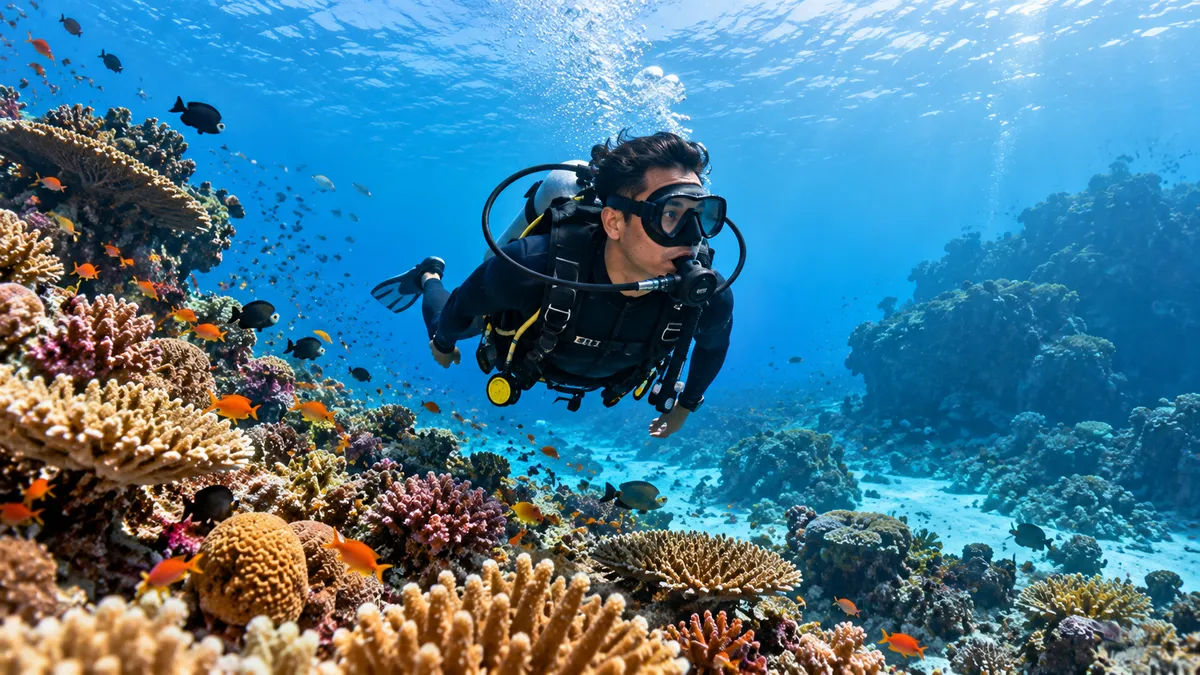
What is the Open Water diver knowledge test?
Entry-level scuba courses such as PADI Open Water Diver include knowledge reviews and a final written exam alongside pool and open water training. The exam is set by the training agency, not by any Malaysian authority. This practice test helps you revise the theory: dive physics, equipment, planning, skills, emergencies and reef care.
The exam format
| Set by | Your training agency and instructor, not a Malaysian regulator |
|---|---|
| Format | Multiple-choice knowledge exam as part of the course. We do not state a question count or pass mark, because we have not confirmed them from the agency |
| Training standard | Entry-level autonomous diver courses follow international standards such as ISO 24801-2 |
| Where Malaysians train | Popular training areas include Tioman, Redang, Perhentian, Sipadan and Mabul |
What the test covers
- Equipment: regulators, alternate air sources, BCDs, gauges, weights and care of gear
- Physics and physiology: pressure, Boyle's, Dalton's and Henry's laws, equalising, narcosis, DCS
- Dive planning, tables and computers: no-decompression limits, safety stops, air use, flying after diving
- Buoyancy and skills: weighting, trim, mask clearing, regulator recovery
- Problem management and emergencies: out of air, cramps, entanglement, lost buddy, oxygen first aid
- Marine environment and conservation: coral, turtles, hazardous animals, marine park rules
- Buddy system and communication: checks, hand signals, surface signals
- Dive safety in tropical conditions: heat, hydration, currents, monsoon seasons, sun
Free official resources, and what we add
Your course materials and instructor are your main source, and the Divers Alert Network publishes free safety guidance. What we add is a bank of 104 original practice questions with explanations and full working for the physics and air calculations, set in Malaysian dive conditions. We are independent and do not reproduce any agency's course materials or exam questions.
How to prepare
- Read each chapter of your course materials before the matching pool session.
- Learn the pressure table: 1 bar at the surface, 2 bar at 10 m, 3 bar at 20 m, 4 bar at 30 m.
- Practise the calculations (gas volume with Boyle's law, air use at depth, partial pressures) until they are automatic.
- Use topic practice here, then a timed mock, and revisit any topic where you drop marks.
- Ask your instructor about anything you are unsure of before your open water dives.
Practice questions with answers
Tap a question to see the correct answer and explanation.
What does the second stage of a regulator do?
- Reduces cylinder pressure to intermediate pressure
- Measures the remaining cylinder pressure
- Releases air from the BCD
- Delivers air on demand at the pressure of the surrounding water
Answer: D, Delivers air on demand at the pressure of the surrounding water. The second stage, in the diver's mouth, opens when the diver inhales and supplies air at ambient pressure. Source: ISO 24801-2 equipment knowledge requirements; US Navy Diving Manual (Rev. 7), open-circuit scuba equipment.
A sealed flexible bag holds 6 litres of air at the surface. What is its volume at 20 m?
- 3 litres
- 4 litres
- 2 litres
- 1 litre
Answer: C, 2 litres. Boyle's law: P1 x V1 = P2 x V2. 1 bar x 6 L = 3 bar x V2, so V2 = 6 / 3 = 2 litres. Source: standard diving physics (Boyle's, Dalton's and Henry's laws), as set out in the US Navy Diving Manual (Rev. 7), Chapter 2; sea water approximated as 1 bar per 10 m.
How does depth affect the no-decompression limit?
- The deeper the dive, the longer the limit
- Depth has no effect on the limit
- The limit is fixed for every dive, whatever the depth or the diver
- The deeper the dive, the shorter the limit
Answer: D, The deeper the dive, the shorter the limit. At greater depth, nitrogen is absorbed faster, so the time available before mandatory stops is shorter. Source: US Navy Diving Manual (Rev. 7), Chapter 3 (underwater physiology and diving disorders).