
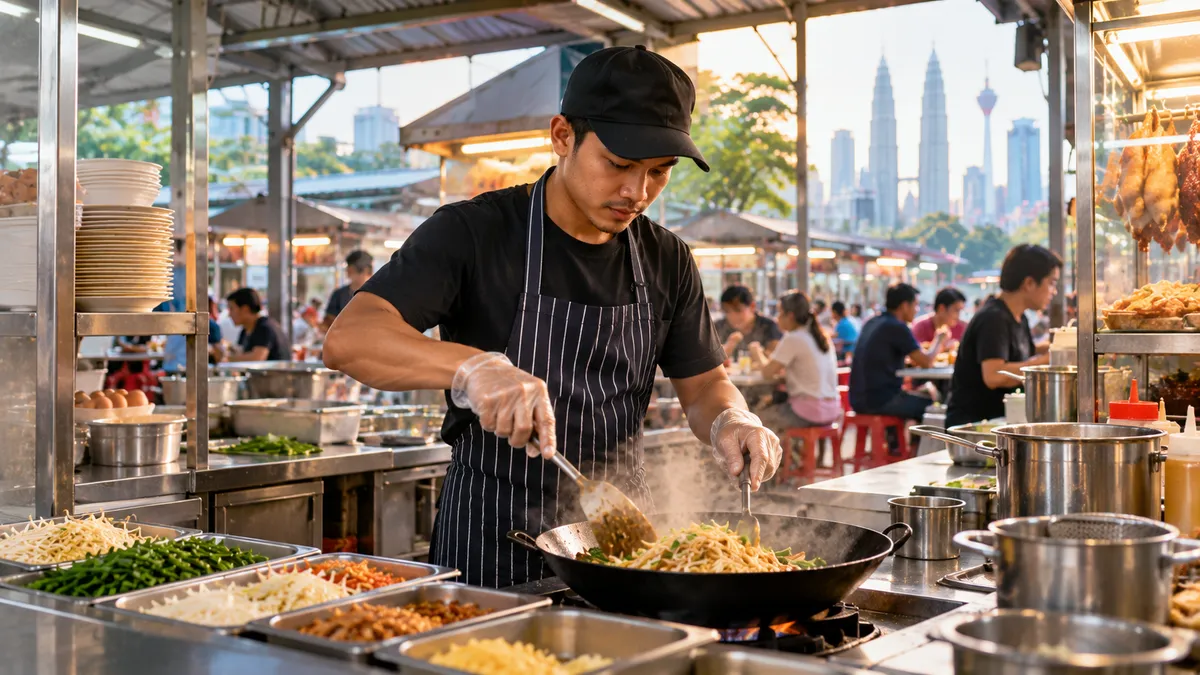
What is the food handler course?
Under regulation 30 of the Food Hygiene Regulations 2009, every food handler in Malaysia, from hotel cooks to hawkers, must attend food handler training at an institution recognised by the Ministry of Health (KKM) and obtain a Certificate of Food Handlers Training. The standard module includes a pre-test and a post-test on food hygiene.
The course and test format
| Who must attend | All food handlers (reg. 30) |
|---|---|
| Where | A KKM-recognised food handler training school (SLPM) |
| Assessment | Pre-test and post-test in the standard module |
| Length | About 3 hours (commonly reported by training providers) |
| Health requirement | Medical examination and vaccination by a registered medical practitioner (reg. 31) |
| Penalty for working untrained | Fine up to RM 10,000 or up to 2 years' jail (reg. 30(3)) |
KKM does not publish a national question count or pass mark for the post-test, and these vary by school. Our timed mock is our own format: 30 questions in 30 minutes.
What the course covers
- The Food Hygiene Regulations 2009 and the duties of handlers and proprietors
- Food-borne illness, including typhoid and carriers
- Personal hygiene, clothing and reporting illness
- Temperature control and storage: chilled food minus 1°C to 10°C, frozen food minus 18°C, hot holding above 60°C
- Cross-contamination and allergens
- Cleaning and sanitising
- Premises, pest control and waste
- Safe preparation and serving
Free official resources, and what we add
The Food Safety and Quality Division of KKM publishes food safety guidance on fsq.moh.gov.my, and the Food Act 1983 and its regulations are published by the Attorney General's Chambers. Your training school provides the course notes. We add 104 original questions in eight topic areas, each with an explanation naming the regulation or guidance it comes from, plus timed mock tests.
How to prepare
- Learn when to wash your hands: before work, after the toilet, after handling raw food (reg. 33).
- Learn the key temperatures in regs. 36 and 38 and the storage distances: 15 cm from walls, 20 cm off the floor.
- Know what to do if you are ill: report it and stay away from food until a doctor certifies you fit (reg. 31).
- Practise one topic at a time here and read every explanation.
- Take a timed mock before your course so the post-test feels familiar.
Practice questions with answers
Tap a question to see the correct answer and explanation.
What is the maximum penalty for a food handler who works without undergoing the required food handler training?
- A fine up to RM500 only
- A written warning for the first offence
- A fine up to RM10,000 or up to 2 years' jail
- A fine up to RM100,000 and closure for 5 years
Answer: C, A fine up to RM10,000 or up to 2 years' jail. Regulation 30(3) makes it an offence, with a fine not exceeding RM10,000 or imprisonment up to two years. Source: Food Hygiene Regulations 2009 (P.U.(A) 95/2009), made under s.34 of the Food Act 1983 (Act 281), reg. 30(3).
How is typhoid usually spread through food?
- Food contaminated by the faeces of an infected person or carrier
- Breathing in steam from cooking pots in a busy kitchen
- Eating food that is very spicy
- Mosquito bites in the kitchen
Answer: A, Food contaminated by the faeces of an infected person or carrier. Typhoid spreads by the faecal-oral route, often when an infected person or carrier does not wash their hands after using the toilet. Source: WHO, Typhoid fact sheet.
What should a food handler wear when handling food?
- Any clothing, as long as it was washed at home the night before
- A clean, light-coloured overall or apron, head cover and footwear
- A dark apron to hide stains
- Street clothes with a cap
Answer: B, A clean, light-coloured overall or apron, head cover and footwear. Regulation 32(1)(b) requires a clean, suitable and light-coloured outer overall or apron, head cover and footwear. Source: Food Hygiene Regulations 2009 (P.U.(A) 95/2009), made under s.34 of the Food Act 1983 (Act 281), reg. 32(1)(b).