
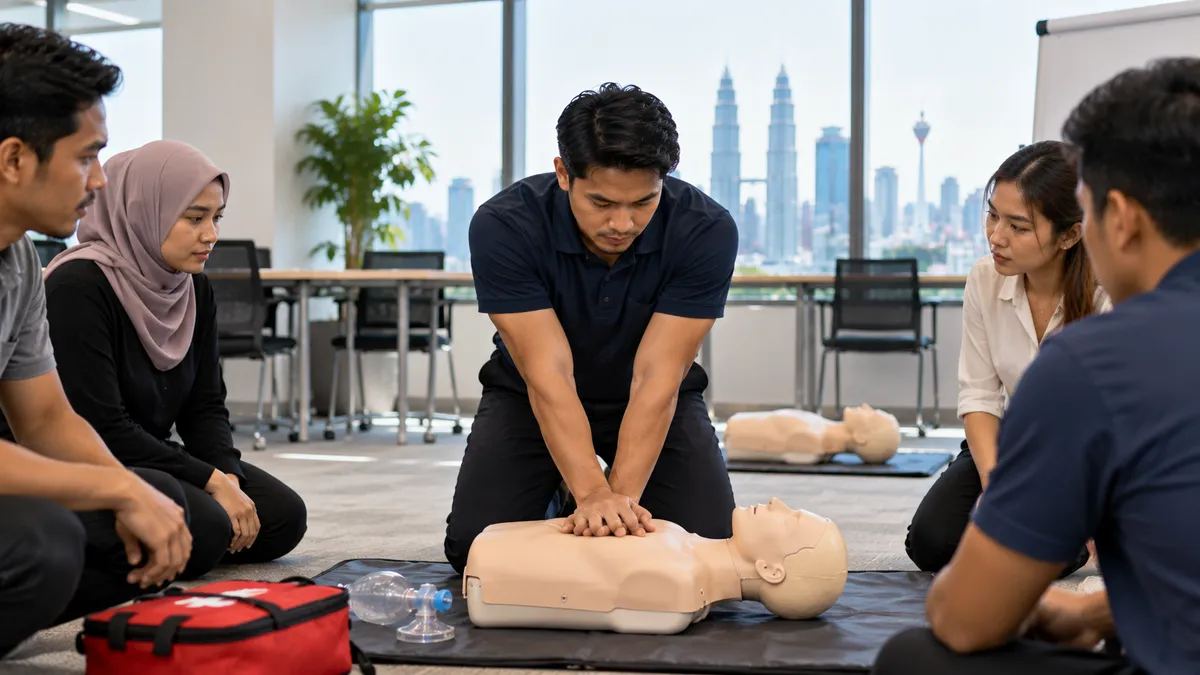
What is the workplace first aid test?
There is no single national written first aid exam in Malaysia. Workplace first aiders usually complete a DOSH-recognised course, such as the 2-day St John Ambulance Malaysia (SJAM) First Aid at Workplace course, which is assessed in theory and in practice. This practice test prepares you for the theory part.
The course and assessment
| Who needs it | Workers appointed as first aiders under their employer's first-aid arrangements |
|---|---|
| Guidance | DOSH Guidelines on First-Aid in the Workplace (2nd edition, 2004) |
| Example course | SJAM First Aid at Workplace, 2 days |
| Assessment | Theory and practical assessment (format set by the training provider) |
| Certificate | Valid for 3 years (SJAM) |
Providers set their own question papers, so we do not claim an official question count or pass mark. Our bank covers the topics every recognised course teaches.
What the test covers
- Principles and scene safety: DRSABCD, consent, protection from infection, calling 999, records
- CPR and AED: compression rate and depth, 30:2, AED pad placement, child and infant CPR
- Choking and airway: back blows, abdominal thrusts, infants, the recovery position
- Bleeding, wounds and shock: direct pressure, tourniquets, embedded objects, amputations
- Burns and scalds: cooling for 20 minutes, chemical and electrical burns, when to go to hospital
- Fractures and sprains: immobilisation, open fractures, RICE, suspected spinal injury
- Medical emergencies: heart attack, stroke (FAST), asthma, low blood sugar, seizures, anaphylaxis
- Heat stroke, poisoning and bites: cooling, swallowed and splashed chemicals, snakebite, stings
Free official resources, and what we add
The DOSH guidelines explain what employers must provide, and the resuscitation councils publish their guidelines free online. Your course manual is your main study text. What we add is a bank of 107 original practice questions, each with an explanation that names its source, plus timed mock exams so you can check your knowledge before the assessment.
How to prepare
- Learn the DRSABCD sequence until you can say it without thinking.
- Memorise the key numbers: 100 to 120 compressions a minute, about 5 to 6 cm deep, 30:2, 20 minutes of cooling for burns.
- Practise one topic at a time here, reading every explanation, including for questions you get right.
- Take a timed mock exam and revisit the topics where you lose marks.
- Practise the hands-on skills on a manikin during your course: the theory only goes so far.
Practice questions with answers
Tap a question to see the correct answer and explanation.
What does the D-R-S in DRSABCD stand for?
- Danger, Recovery, Stabilise
- Defibrillate, Rescue breaths, Shock the casualty
- Danger, Response, Send for help
- Diagnose, Reassure, Splint
Answer: C, Danger, Response, Send for help. DRSABCD is Danger, Response, Send for help, Airway, Breathing, CPR, Defibrillation. It sets the order a first aider follows for an unresponsive casualty. Source: first aid action plan used on DOSH-recognised workplace first aid courses; ERC Guidelines, Basic Life Support.
How deep should chest compressions be for an adult?
- About 2 to 3 cm
- About 5 cm, and no more than 6 cm
- About 3 to 4 cm, to avoid breaking ribs
- At least 8 cm, as deep as you can push
Answer: B, About 5 cm, and no more than 6 cm. Guidelines recommend a depth of about 5 cm and no more than 6 cm in adults. Shallow compressions move too little blood; very deep compressions increase injury. Source: European Resuscitation Council (ERC) Guidelines, Basic Life Support; AHA Guidelines for CPR and Emergency Cardiovascular Care.
A conscious adult is choking and cannot speak, cough or breathe. What do current guidelines recommend?
- Give water to wash the object down
- Sweep the mouth blindly with a finger
- Up to 5 back blows, then up to 5 abdominal thrusts
- Lay them down and start giving rescue breaths straight away
Answer: C, Up to 5 back blows, then up to 5 abdominal thrusts. For severe choking, give up to 5 firm back blows between the shoulder blades, then up to 5 abdominal thrusts, and keep alternating. Blind finger sweeps can push the object deeper. Source: European Resuscitation Council (ERC) Guidelines, Basic Life Support; AHA Guidelines for CPR and Emergency Cardiovascular Care.